
I’m not a football coach or team tactician but looking at our tactics on Friday night away to Wexford it was very evident that our tactics were going to cause a lot of problems for us in defence.
Our tactics on the night were to play a high press to compress the Wexford team by playing a high defensive line but as we saw against Shamrock Rovers last Sunday, this approach can lead to our downfall.
So, lets take a look at what the High Line tactic is and why some teams decide to use it, and should Dundalk be using this tactic?
What is the High Line?
The High Line is a tactic whereby a team who adopts an attacking approach will move their defensive line up to the centre circle to compress the opposition midfield to reduce the space and reduce the options for the opposition.
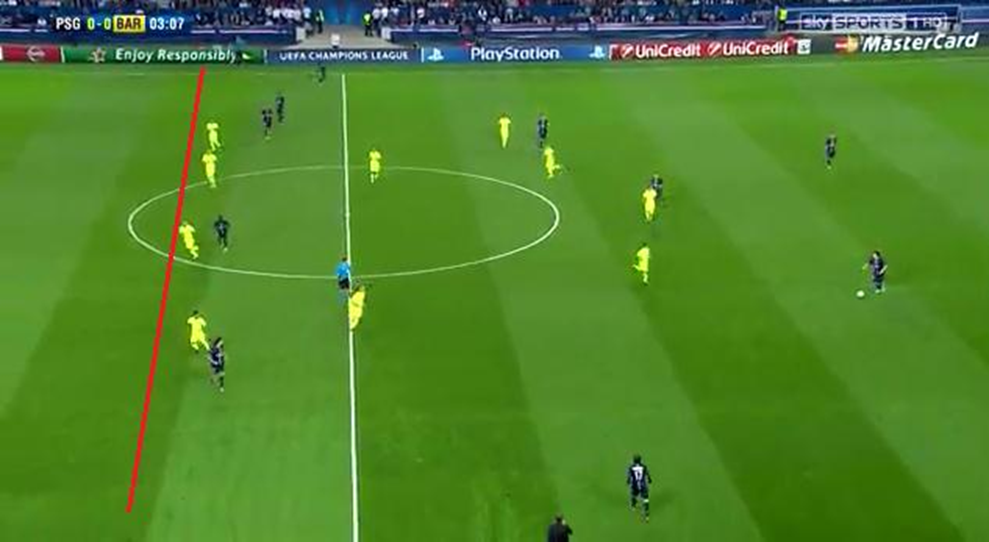
The High Line tactic reduces the space and allows the attacking team to play the game in the opposition’s half, the space is limited for the opposition to create any attacking options, and it puts the opposition under a lot of pressure.
It’s a high possession tactic and can be very effective when played with the correct criteria, but there are also some weaknesses if the high line is breached.
The benefits of playing the High Line:
- Its limits the space in the opposition half.
- It keeps the opposition away from your defensive area.
- With high pressure, the ball can be retrieved quicker, and the pressure can be kept on the opposition.
The weakness of playing the High Line:
- There is plenty of space behind the defence, a quick back line is required to track back if a ball is played over the top or through space in the defence.
- The possibility of the opposition forwards being one on one with the keeper if a counterattack is successful.
- A fast forward line can wreak havoc if the defence is caught for pace.
What is required to play the High Line effectively?
Good Communication.
In the first half of the season, Dundalk had the best home record in the league. We conceded 13 goals up until the mid-season break, the departure of Mark Connolly during this period was seen as a major loss, Mark was a leader on the pitch and was effective in organising the defence and controlling the offside trap.
Our current back line has plenty of experience, so I think Good Communication is something we have in order to play this tactic.
A Defensive Leader.
I don’t want to keep referring to the departure of Mark Connolly, but he was a leader for us in the defence, he commanded the back line and organised them. Since his departure we have seen the likes of Sam Bone step up to fill this role with very impressive results. The partnership of Sam Bone and Andy Boyle definitely has a lot of potential for many a season to come.
We also have Andy Boyle in this role, Andy is a true leader and is well capable to organise the troops.
Experience.
We have plenty of experience, not just in our defence line, but throughout our team. I believe we are well covered in this department.
Speed in Defence.
I believe this is our major weakness in our defensive line, with our back line being so high up the pitch in order to compress the opposition, this leaves a lot of open space behind us, it’s a critical requirement of this tactic to be able to track back quickly if the opposition slip a back through or cross it over the top, we saw this against Shamrock Rovers in Tallaght and we also saw it against Wexford in the FAI cup.
With the current injuries within the Squad we are very vulnerable in this area.
A Sweeper Keeper.
In order to play this tactic its important to be able to have a keeper who is quick of their line to clear or collect any through balls from the opposition, thankfully we have the best sweeper keeper in the league in the form of Nathan Sheppard.
Nathan is quick of this line, capable of heading and clearing the ball, and he is also one of the best distributors of the ball in the league.
We are well covered in this area.
Offensive players tracking back.
This is another weakness given the current injuries within the squad. The injury list is putting a lot of pressure on the current players to track back from attacking positions when we lose the ball, its going to take its toll on our fitness levels.
The loss of Pat Hoban and Paul Doyle are evident of this, when Pat Hoban is playing he is capable of holding up the ball, tormenting defensive lines and not giving them a chance to settle or organise their back lines, his loss on the pitch allows the opposition back line to look up, take their time and pin point a pass over the top in to the open space, a tactic that Shamrock Rovers exploited numerous times recently.
Should Dundalk be using the High Line?
So, this poises the question, should Dundalk FC keep playing this tactic?
Firstly, I’m not a football coach. In no way am I telling any of the coaching staff how to manage the squad, but from analysing the recent games there are definitely some vulnerabilities within the squad due to recent injuries and departures.
The main vulnerability is speed, especially while tracking back in defence, this is the result of losing some of our midfield and holding players to injury and losing some players to suspensions and departures.
When playing the highline if we lose the ball high up the pitch and a ball is played through our defence, the entire team instantly needs to track back and defend, given the distance between our initial defensive line and our keeper, that distance can simply be too great to cover.
In my opinion, for what its worth, I think allowing some of the back line to move up while keeping a defensive presence in our own half would be a better approach, it means we can continue to press the opposition and put pressure on them while having a presence in defence if the opposition counterattack.
At the moment, our scoring rate is higher than our conceding rate, its currently 70% scoring rate to 56% conceding rate, this is something we can look at as a positive, essentially, we are scoring more than we conceded, definitely a plus, but the conceding percentage has increased recently, a stat to keep an eye on and with the return of players from injury, hopefully something we can improve on.
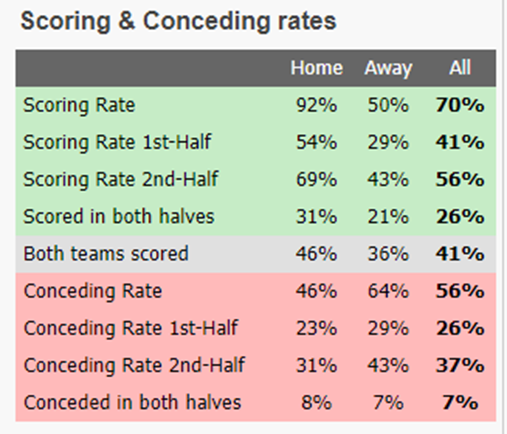
Our clean sheet record is currently standing around 44% for the season so far, this is one of the best in the league, but a worrying stat to keep a close eye on is our failed to score stat which is currently at 30% for the season so far, essentially down to our poor away record.
In the coming weeks we will hopefully see the return to the squad of those players from injury, but with an away game to Sligo Rovers tomorrow night (Monday night) and a home game to Shelbourne in Oriel this Friday, the use of such a risky tactic might not be advisable given the vulnerabilities in our defence.
End.